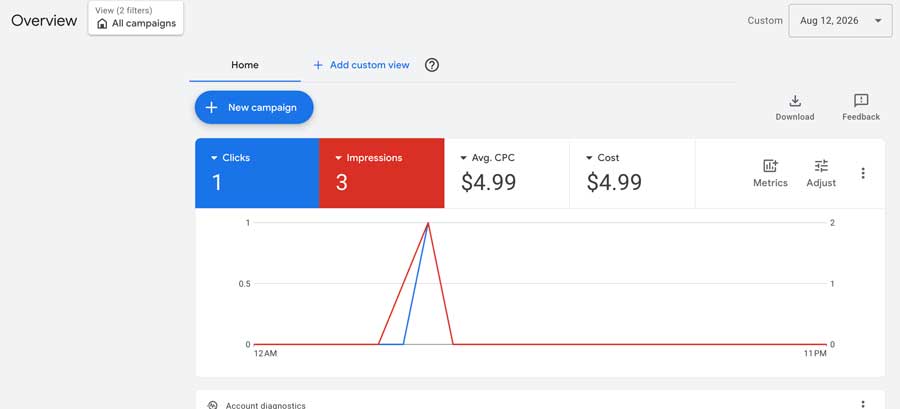
Of all the rules attached to the Google Ad Grant, the 5% click-through rate requirement is the one that quietly ends accounts. Not because it is unfair, and not because it is hard to meet, but because almost nobody is watching the number until the month it goes wrong.
Here is exactly what the rule says, exactly what happens when you miss it, and what to do in the two or three weeks when you can still fix it.
The rule, stated plainly
Your Ad Grant account has to maintain a click-through rate of at least 5% every month. Miss it for two consecutive months and Google temporarily deactivates the account.
Three details in that sentence do most of the damage, because they are the parts people get wrong.
It is measured at the account level, not per campaign
Google divides every click in the account by every impression in the account for that calendar month. One campaign at 12% does not protect you if another is dragging along at 1.5% on ten times the impressions. The volume matters as much as the rate, which is why a single ignored keyword can sink an otherwise healthy account.
One bad month is a warning, not a penalty
Nothing happens after a single month below 5%. The consequence lands only after the second consecutive month. That gap is the entire opportunity, and it is why watching this number monthly is worth more than any other reporting habit you could build.
“Temporarily deactivated” means the ads stop
Your account is not deleted and your history is not erased, but your ads stop serving, and they stay stopped until you fix the underlying problem and formally request reinstatement. In practice that means a minimum of several days with zero visibility, usually more, and all of it avoidable.
Who is exempt
A few accounts are not measured against this rule, and it is worth knowing whether you are one of them before you spend a week optimizing for a threshold you do not have to meet.
- Brand new accounts get a 90 day grace period to reach 5%.
- Accounts running only Smart campaigns are exempt from the CTR requirement entirely.
- Performance Max campaigns are excluded from the CTR calculation, so their impressions and clicks do not count either way.
Everyone else is measured, every month, with no exceptions for seasonality, staff turnover, or the fact that nobody has logged in since March.
Why accounts actually fail it
In our experience the cause is almost never the ad copy, which is where most people start looking. It is nearly always a small number of keywords generating an enormous pile of impressions and almost no clicks.
That happens for a few predictable reasons:
- Broad match on general terms. A keyword like volunteer or donate on broad match will match thousands of searches that have nothing to do with your organization. Every one of those is an impression, and almost none of them is a click.
- No geographic targeting. A regional food bank showing ads nationwide collects impressions from people who will never click, because the ad is irrelevant to where they live.
- Keywords that describe your work instead of the search. “Youth empowerment programming” is how the annual report says it. It is not what a parent types at 11pm.
- Ads pointed at the homepage. When every ad group sends traffic to the same generic page, relevance falls, and with it the click-through rate.
What the math actually looks like
This is the pattern we find on real audits often enough that it is worth showing with numbers. Consider an account sitting at 4.0% for the month:
| Segment | Impressions | Clicks | CTR |
|---|---|---|---|
| One broad match keyword | 22,000 | 260 | 1.2% |
| Everything else | 18,000 | 1,340 | 7.4% |
| Account total | 40,000 | 1,600 | 4.0% |
The account is failing. The account is also, in every part that matters, performing well. Pausing one keyword moves it from 4.0% to 7.4% without touching a single ad, a single bid, or a single landing page.
The fastest way out of a CTR problem is almost always subtraction, not addition.
This is Google’s own first piece of advice on the subject, and it is correct: pause the high-impression, low-CTR keywords. It feels wrong, because those keywords look like reach. They are not reach. They are a tax on every other keyword in the account.
What to do, in order
- Find out where you actually are. Pull account-level CTR for last month and this month to date. If last month was under 5%, you are in the warning month right now and the clock is real.
- Sort keywords by impressions, descending. Not by cost, not by conversions. Impressions. The problem is always near the top of that list.
- Pause anything with high impressions and CTR under about 2%. You can rebuild those terms later with tighter match types. Right now they are the emergency.
- Move general terms off broad match. Phrase and exact match cut the irrelevant impressions that broad match invites.
- Set proper geographic targeting. If you serve three counties, say so. This is separately required by the program rules anyway.
- Then, and only then, improve the ads. Better copy raises CTR at the margin. It will not rescue an account that is being buried by one keyword.
If you have already been deactivated
It is recoverable, and it is not a moral failing. The process is: fix the underlying compliance problem first, then submit a reinstatement request to Google through their contact form. Requesting reinstatement without fixing the cause simply restarts the same two month countdown, so the repair has to come first.
The more useful question after reactivation is why nobody saw it coming. An account that hits this rule once will usually hit it again, because the thing that actually failed was not the CTR. It was that no one was looking.
The honest summary
The 5% rule is not a difficult standard. A tightly built Ad Grant account clears it comfortably and permanently, often sitting in the 8% to 15% range without anyone having to think about it. Accounts fail this rule when they are set up once and then left alone for a year, which describes a great many grant accounts, including some that were built by people who charged for the privilege.
If you do not know what your account-level CTR was last month, that is the single number to go find today. It takes about ninety seconds, and it is the difference between a routine adjustment and a reinstatement request.
Related reading: Your Ad Grant is active but spending almost nothing. Here’s why.
Program rules are summarized from Google’s Ad Grants policy compliance guide and account management policy. Google updates these periodically, so verify current requirements before acting on them.