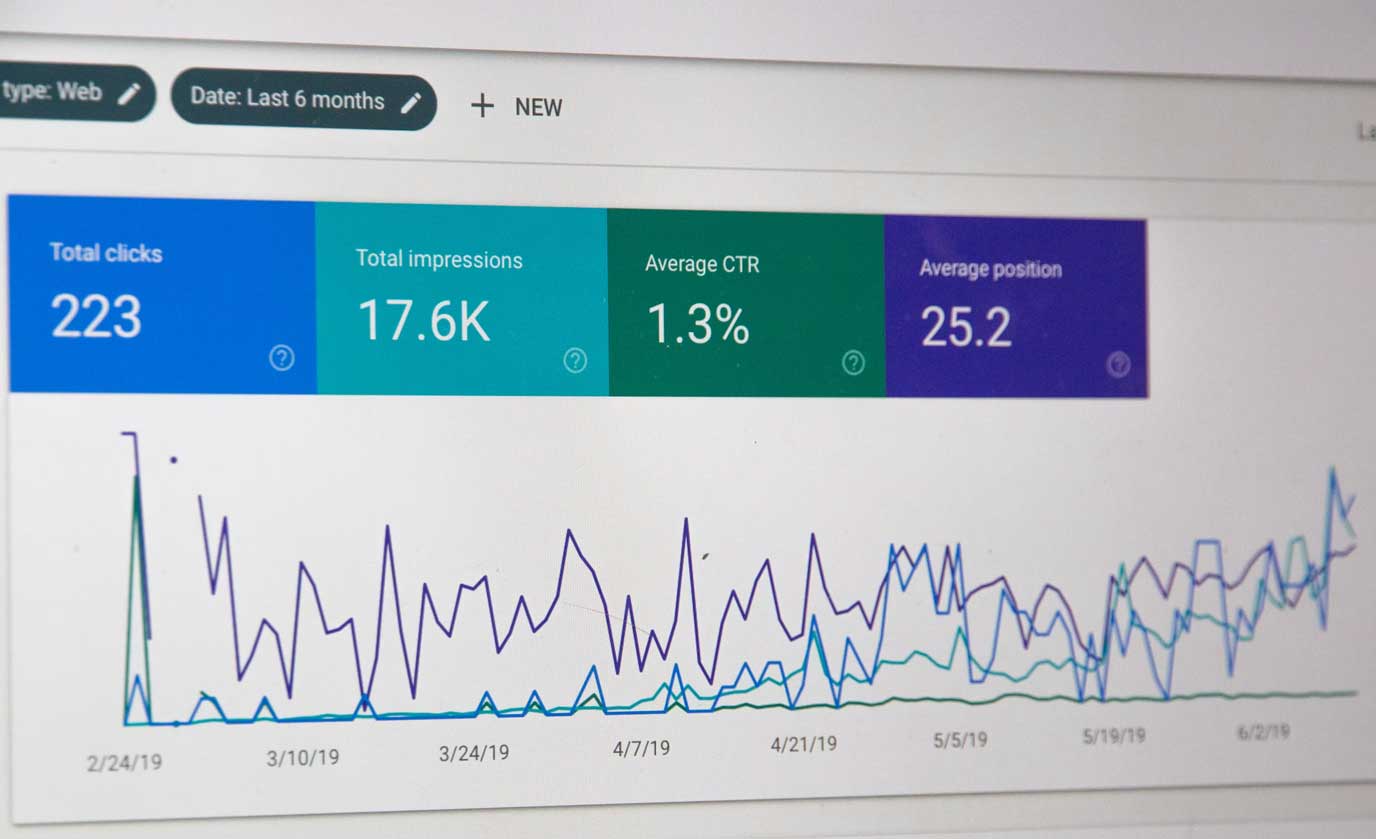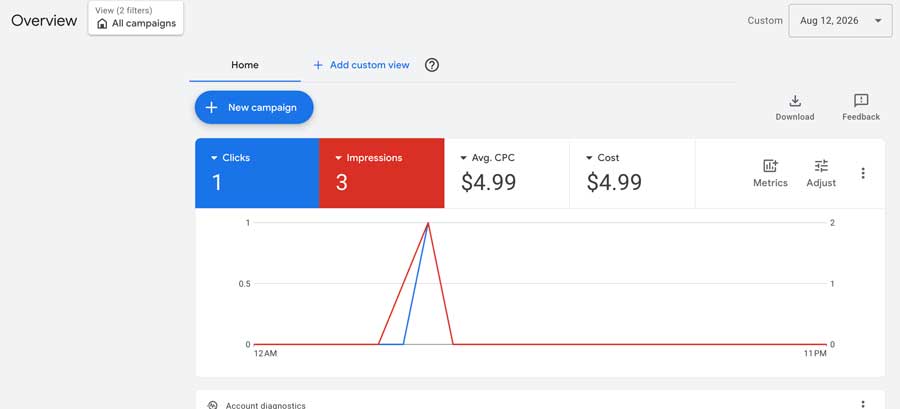
This is the most common finding on the audits we run. The Ad Grant is approved. The account is active. Nothing is suspended, nothing is flagged, and every compliance box is ticked. And the monthly spend is $94 out of a possible $10,000.
Nobody gets an alert for this, because nothing is technically wrong. The account is simply invisible, and it has usually been invisible for a very long time.
There are six reasons this happens. They are worth checking in this order, because the first two account for most of it and take about twenty minutes to rule out.
1. The $2 bid cap is holding you under the auction
Ad Grant accounts are limited to a maximum cost-per-click of $2.00. Plenty of nonprofit-adjacent keywords clear $2.00 easily, and when your maximum bid sits below what the auction costs, you do not lose narrowly. You simply do not appear.
The important part, and the part that most account owners have never been told: the $2.00 cap does not apply when you use the Maximize conversions bidding strategy. Switch to it and you can compete at real market rates. The cap still applies to manual CPC, Maximize clicks, Target CPA, and Enhanced CPC.
That single setting is frequently the entire explanation for an account spending under $100 a month.
One caution, because this cuts both ways: Maximize conversions will spend your full daily budget without regard for what a conversion costs. If it can get conversions at $45 when $18 was achievable, it will not correct itself. It needs a competent hand on it, and it needs real conversion tracking underneath, which brings us to the reason it often does not work at all.
2. Conversion tracking is missing or measuring nothing
Accounts created after April 22, 2019 are required to use conversion-based Smart bidding, and those strategies need conversion data to function. If your conversion tracking is broken, absent, or pointed at something meaningless, the bidding algorithm has no signal, and an algorithm with no signal bids conservatively and spends almost nothing.
Two specific traps:
- Tracking that never fired. The tag was installed during setup, the site was rebuilt in 2023, and nobody re-checked. This is extremely common and completely invisible from inside the Ads interface.
- Conversions that are not conversions. Time on site and homepage visits are explicitly not allowed in the Conversions column under the program rules. Beyond the compliance issue, they teach the algorithm to chase people who bounce slowly.
The program also expects at least one conversion per month for accounts created after that date. An account reporting zero conversions month after month has a measurement problem, a targeting problem, or both.
3. The daily budget was never raised
The $10,000 monthly ceiling works out to roughly $329 per day. Accounts are sometimes left at a far lower daily budget from initial setup, which caps spend at a fraction of what is available regardless of how well everything else performs.
This one takes thirty seconds to check and is worth checking first precisely because it is so mundane.
4. Your keywords have no search volume
Organizations tend to write keywords in their own vocabulary. “Food insecurity intervention” is accurate, defensible, and appears in your grant reporting. It is also searched by roughly nobody. “Free food bank near me” is searched constantly.
An account built entirely from internal language will be perfectly compliant and almost entirely unseen. The fix is not clever, it is just uncomfortable: write the words your beneficiaries and donors actually type, including the plain ones.
Note that the program separately prohibits single-word keywords, with limited exceptions for brand terms and certain medical conditions, and prohibits overly generic keywords that carry no clear intent. The target is specific and natural, not broad.
5. Geographic targeting is too narrow, or wrong
Proper geographic targeting is required by the program, and it is also easy to overtighten. A radius drawn around a single office address will exclude most of the region a service actually covers. It is worth confirming the targeting matches the service area rather than the mailing address.
6. Quality Score is suppressing you
Keywords with a Quality Score of 1 or 2 must be paused or removed under the program rules. Before you get to that threshold, though, low scores raise what you effectively have to bid to show at all, which compounds the $2.00 cap problem from reason one.
Quality Score is largely driven by the relevance chain: does the keyword match the ad, and does the ad match the landing page? Accounts that send every ad group to the homepage break that chain everywhere at once.
A caution about the goal
It is easy to read all of this as an instruction to spend the full $10,000, and that is not the point.
Full spend is not the objective. The objective is the outcome the spend produces, and the two come apart more often than anyone admits.
An account spending $3,000 a month on searches from people actively looking for what you do is worth considerably more than one spending $9,800 on broad terms that generate traffic and nothing else. It is entirely possible to fix an underspending account by making it worse, simply by opening the taps on keywords that convert nobody.
Spending $94, though, is not restraint. It means that in a month when thousands of people searched for something you provide, you were absent from effectively all of it. That is the problem worth solving, and the ceiling is just the ceiling.
The twenty minute version
If you want to check this yourself before talking to anyone, in order:
- Look at the daily budget. Is it near $329?
- Look at the bidding strategy. Is it Maximize conversions, or is it something still capped at $2.00?
- Look at the Conversions column. Is there a number in it, and does that number represent something real?
- Look at your top twenty keywords. Would a stranger type those words?
- Look at the location settings. Do they match where you actually work?
Most underspending accounts fail at step two or step three, and both are fixable in an afternoon by someone who has done it before.
Related reading: The 5% CTR rule, and what actually happens when you miss it
Program rules are summarized from Google’s Ad Grants policy compliance guide and account management policy. Google updates these periodically, so verify current requirements before acting on them.